
Welcome to Data Insights: More Than a Moment. A series unpacking key data from the latest Women’s Sport Trust Visibility Report – what it shows, and why it matters now for women’s sport.
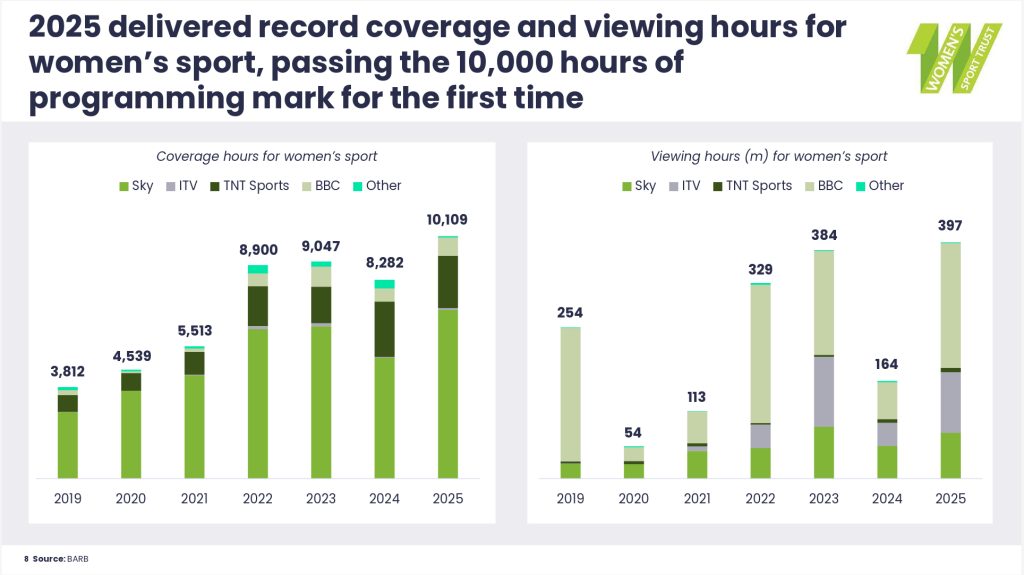
Women’s sport is reaching more people than ever before. In the UK, overall broadcast reach climbed to 48 million viewers in 2025, making it the most-watched year for women’s sport on record. Total viewing hours also reached a new high, with 397 million hours across free-to-air and pay-TV, from a record 10,109 coverage hours, reflecting sustained growth across broadcast channels.
But when we look more closely at where the biggest gains in attention are coming from, a familiar pattern emerges. Major global tournaments continue to do much of the heavy lifting.
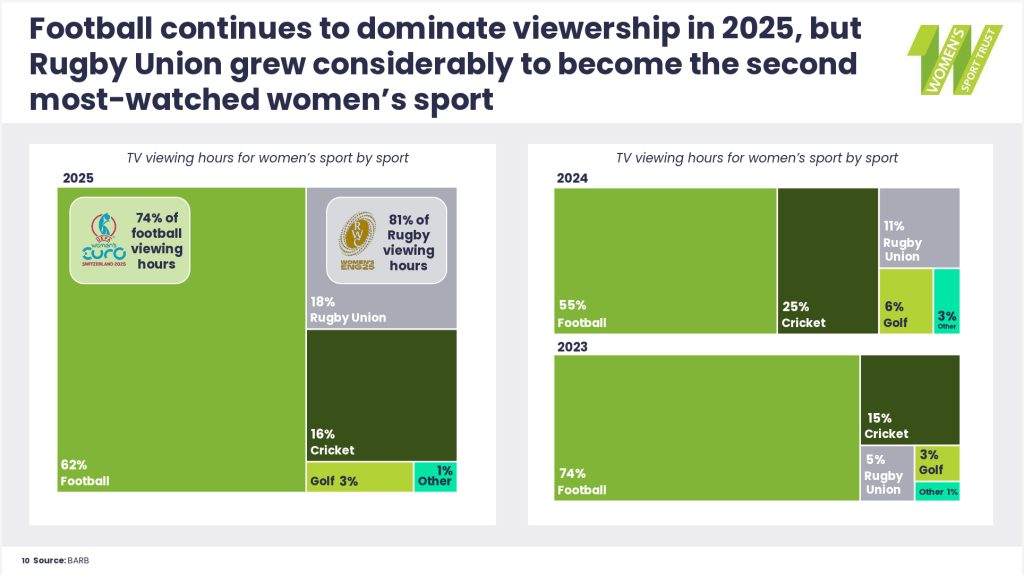
Football remained the dominant driver of women’s sport viewership in 2025, accounting for 62% of total TV viewing hours. However, 74% of that football viewing concentrated around the UEFA Women’s EURO. Rugby Union became the second most-watched women’s sport, generating 18% of total viewing hours, but 81% of rugby viewership was driven by the Women’s Rugby World Cup. Also, these two tournaments accounted for nine of the ten most-watched moments in women’s sport during the year.
What does this really mean?
Two global tournaments accounted for just over 60% of all women’s sport TV viewing in 2025, that’s 240 million of the 397 million total hours.
The data shows that attention is being driven by major events. While these moments can deliver reach and visibility at scale, that attention is not yet being sustained consistently across the wider women’s sport calendar.
Why this matters now
For women’s sport to move from these moments to maturity, reliance on peaks alone isn’t enough. Growth built only on major tournaments risks remaining cyclical, rather than cumulative.
Our data highlights the role of factors such as consistent scheduling, clear narratives and regular visibility in supporting more sustained audience engagement over time.
These conditions help create more opportunities for audiences to reconnect outside major tournament windows and build repeat engagement.
At a point when women’s sport is reaching record audiences, the ability to build repeat engagement between major moments will shape if and how that growth develops. This is particularly relevant in years without a major global women’s tournament on a major Public Service Broadcaster, like BBC or ITV.
Read the full report – Download More Than A Moment for free to explore the data shaping women’s sport.